
ADVERTISEMENT

Sympathetic Resonance: Acoustic and Digital String Resonances

Chord Sympathetic Resonance
(Photo: Jörg Sunderkötter)
ADVERTISEMENT

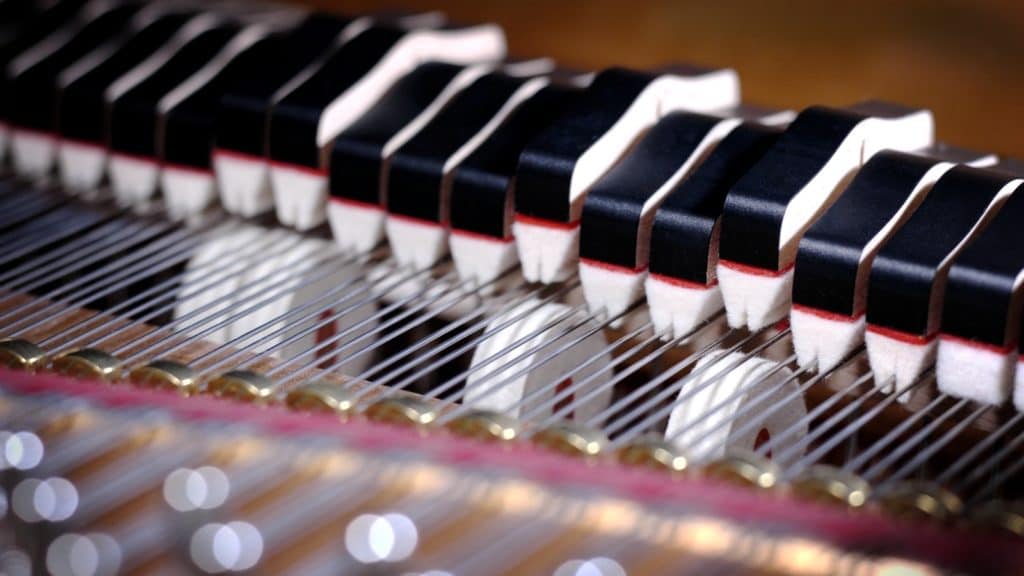
Sympathetic resonance is an essential part of any piano sound. These resonances occur between harmonically related notes, hence the term “sympathetic”. While the interaction of strings and damper is the source of sympathetic resonance on an acoustic piano, it must be artificially recreated on a digital piano.

ADVERTISEMENT
ADVERTISEMENT

String Resonances Are Complex

Damper resonance on digital pianos refers to resonances that occur in direct connection with the damper (sustain) pedal. Here, all strings are free to vibrate. In contrast, in acoustic and upright pianos the string of a single note (played without sustain pedal) can also resonate in sympathy when you play other notes. How and to what extent a string resonates depends on whether the notes struck match the overtone spectrum of the undamped string. When talking about digital pianos, this overtone-dependent interaction is for example called Sympathetic Resonance (Roland Piano Designer), String Resonance (KAWAI Virtual Technician), or Virtual Resonance Modeling (VRM, Yamaha Piano Room/Smart Pianist).

There must be a relation between the overtones of the resonating notes. If that’s the case, sympathetic resonance can shape the sound significantly, even when you play in only two voices. However, these resonance effects are much more subtle than the damper resonance when playing the sustain pedal. Nevertheless, they are an essential part of the harmony of the notes and chords you play. The matching overtone spectrum results in complex relations that dynamically influence the sound of an acoustic grand piano.

The sound generators of modern digital pianos have fairly authentic-sounding simulations of sympathetic resonance. In addition, you can even customize the sound characteristics. Some digital pianos generate string resonances using special samples, while others use physical modeling technology.

Digital pianos that cannot accurately reproduce string resonance are missing an essential component.

Making Sympathetic Resonance Audible

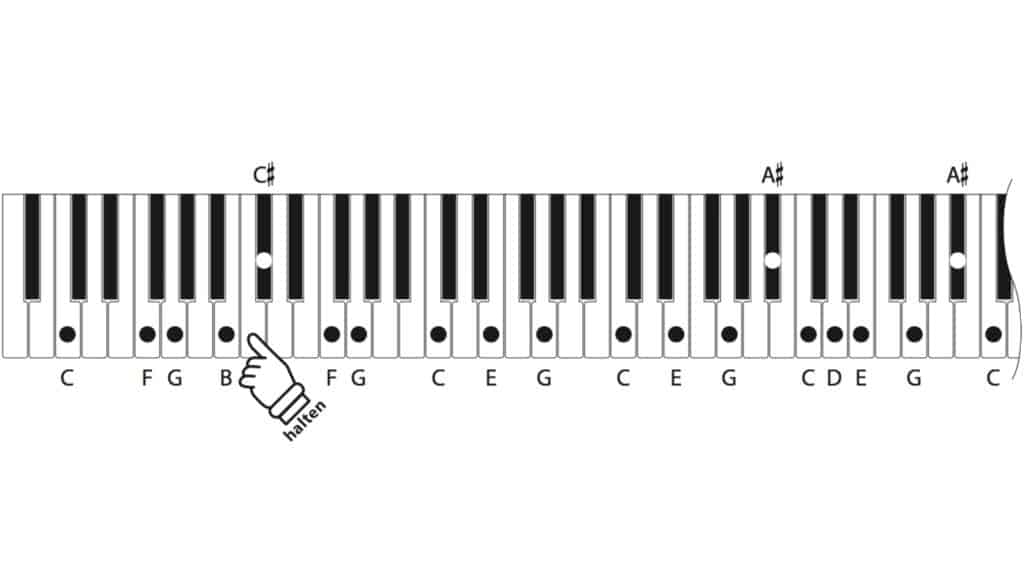
Figuring out the relations between string resonances yourself is quite simple. First, play a key very softly or silently and hold it. Now briefly play notes that match this fundamental note (staccato). You will notice that the open strings reflect the corresponding overtones as resonance. So if you hold the C as shown in the picture and briefly play the G, the G will continue to vibrate softly as an overtone in the held C.

Sympathetic Resonances (Image Source: Kawai)

String Resonances & Piano Playing

The example above is for illustrative purposes only, though you can play very melodically using overtones if you wish. In modern piano literature, you can even find instructions for playing notes and chords silently, so that these notes – now undamped – act as harmonic resonators for the notes you play with the other hand.

Even if you just hold a single note, it will affect the sound, as the harmonic relations change over time. This naturally depends on the other notes you are playing in the context, e.g. in two-part melodies with sustained notes. If you play the C note as in the example above, notes in the melodic progression of the second voice will produce resonances in the decaying note. Digital pianos that cannot accurately reproduce string resonance are missing an essential component.

ADVERTISEMENT

Related Articles

20.09.2025 · Buy Yamaha CLP-800 Series – Reviewing Clavinova Digital Pianos

In fall 2024, Yamaha announced the new CLP-800 series. The key refinements concern the sound generation and playback systems.

01.09.2025 · Buy Buyer’s Guide: A Portable Piano Under $2,000

With a scaled-down cabinet and speaker system, a portable piano under $2,000 offers a great keyboard and sound engine.

20.02.2025 · Buy Studiologic SL-mk2 Series – USB MIDI Controllers

The Italian manufacturer has introduced the new models of the Studiologic SL-mk2 series with new features and improved details.

20.02.2025 · Buy Speakers and Piano Sound: How Good Can Digital Pianos Really Sound?

Speakers and piano sound — does your digital piano sound better when you're using headphones? Find out why here.

13.02.2025 · Buy Kawai CN Series: CN-201 & CN-301

With their high-quality playability, the digital pianos in the Kawai CN series inspire both demanding beginners and advanced players.

09.02.2025 · Buy Product Review: Yamaha TransAcoustic Piano - Hybrid Piano

Piano or digital piano? The Yamaha TransAcoustic piano offers the best of both worlds. The perfect blend of acoustic and digital piano.

08.02.2025 · Buy Almost as Good as the Real Thing: Playing a Hybrid Digital Piano

Acoustic soundboard, grand piano action, and wooden keys: A hybrid digital piano combines maximum playing comfort with high-quality sound.

07.02.2025 · Buy Play Piano with Headphones: Hybrid Piano!

Play the piano with headphones - a hybrid piano combines an acoustic piano with a mute function and an electronic sound generation.

15.01.2025 · Buy Best Headphones for Digital Piano: Sound That Inspires

Buying high-quality headphones for digital piano: Why invest in good digital piano headphones and how much do they cost?

13.01.2025 · Buy Kawai ES Series: ES-920, ES520, ES-120, ES-60 – Portable Pianos

The Kawai ES Series is popular with beginners and advanced players alike: High-quality features at prices ranging from $400 to $1,200.

22.12.2024 · Buy Wireless MIDI: Play Piano or Keyboard Without Cables

Wireless MIDI systems are useful when the instruments themselves are not Bluetooth-compatible. But what makes a good Wireless MIDI adapter?

20.12.2024 · Buy Studiologic SL Series: SL73/88 Studio, SL88 Grand, SL|Mixface

The Studiologic SL series offers USB MIDI controllers with high-qualtiy hammer action keyboards for MIDI studio and live use.