ADVERTISEMENT

What Is USB MIDI/Audio on Digital Pianos?

  • The USB MIDI/Audio function enables a data connection between the piano and mobile devices, which simultaneously transmits audio and MIDI signals.
  • USB is available on all digital pianos, but in most cases, you can only use it to establish a MIDI connection.
  • Unlike Bluetooth, USB MIDI/Audio provides a more stable connection with lower latency.
korg-b2-module-pro-scarbee-ep88
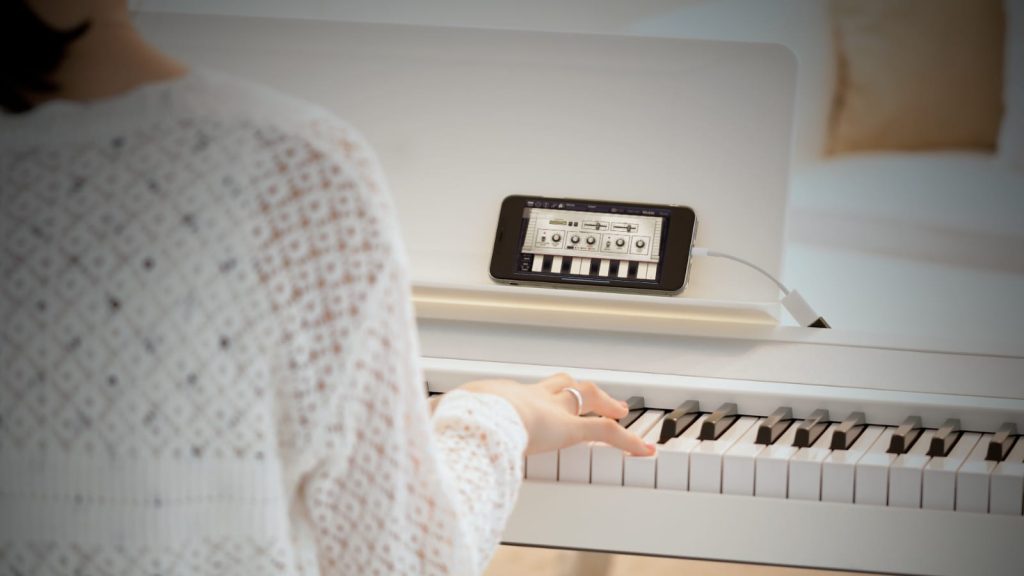
Cool Rhodes sounds from the Scarbee EP-88m—with USB MIDI/Audio, you only need a simple USB cable to connect the Korg B2 and Korg Module Pro. (Source: Korg & More)
ADVERTISEMENT

Digital pianos and mobile devices are a combination that has become increasingly important in recent years. Whether it’s an iPad or other device, the USB MIDI/Audio function provides the simplest and most reliable connection between digital pianos and external devices.

ADVERTISEMENT
ADVERTISEMENT

If you use audio interfaces to connect to your computer, you are probably familiar with the digital transmission of audio and MIDI data over USB. These interfaces provide a connection to the outside world, allowing you to work with microphones, electric guitars, and MIDI instruments. The USB MIDI/Audio connection on digital pianos works the same way, but its purpose is different.

USB MIDI/Audio: The Benefits

The USB MIDI/Audio function on a digital piano allows for the full integration of computers or mobile devices for music production via a single USB cable. This means: USB MIDI allows you to use the piano to control an application on a mobile device (e.g., Korg Module Pro), which sends its sound back to the digital piano via USB Audio.

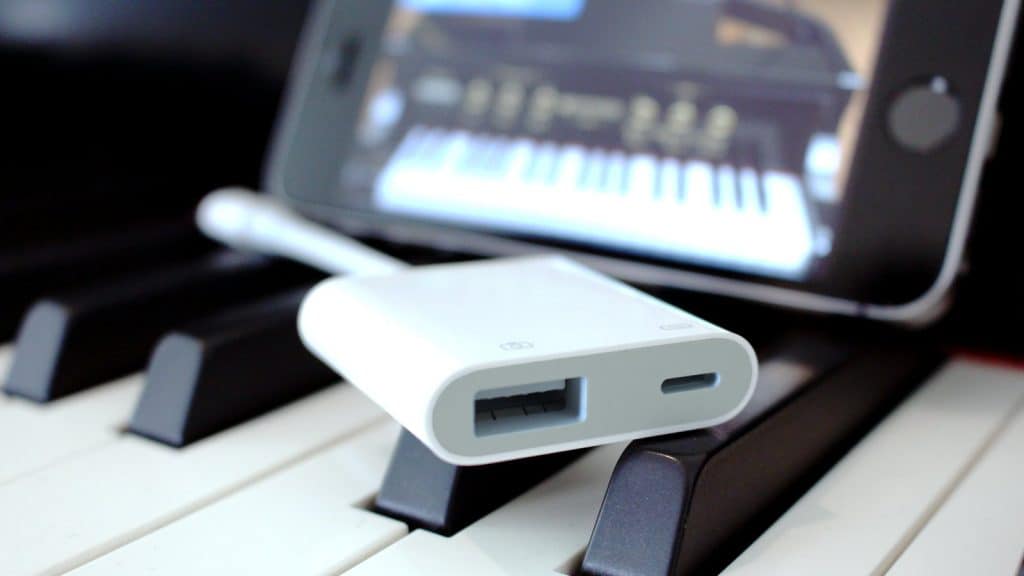
However, unlike digital pianos with only USB MIDI, digital pianos with USB MIDI/Audio require an OTG adapter and additional accessories, such as audio cables or mixing consoles. The OTG adapter is necessary for the USB connection between the mobile device and the piano.

Connecting the iPad to the piano using the Lightning Camera Connection Kit: You should choose the adapter with the additional Lightning connector, which powers the iPad/iPhone during operation.

Which Digital Pianos Support USB MIDI/Audio?

Since this is a relatively new trend, manufacturers frequently release new models with this feature. Some Yamaha digital pianos have conveniently supported USB MIDI/Audio for a while now. Examples include the current Clavinova and Arius models, the Yamaha P-515, the new P-145 and P-225 portable pianos, and even the smallest NP-35 Piaggero keyboard.
Other USB MIDI/Audio-capable models include Korg’s Liano and B2 portable pianos, the Thomann SP-120, and Studiologic and Viscount stage pianos.

You can find an overview of the current models on our Thomann landing page.*

Digital pianos with USB MIDI/audio capabilities make it easy to use an iPad as a sound source for live performances. If you want to use piano apps such as Korg Module Pro, Modartt Pianoteq 8, or e-Instruments Pure Piano for performances, there are many designs and price points to choose from.

Below are five digital pianos that we find particularly interesting in the context of USB MIDI/Audio.

Korg Liano

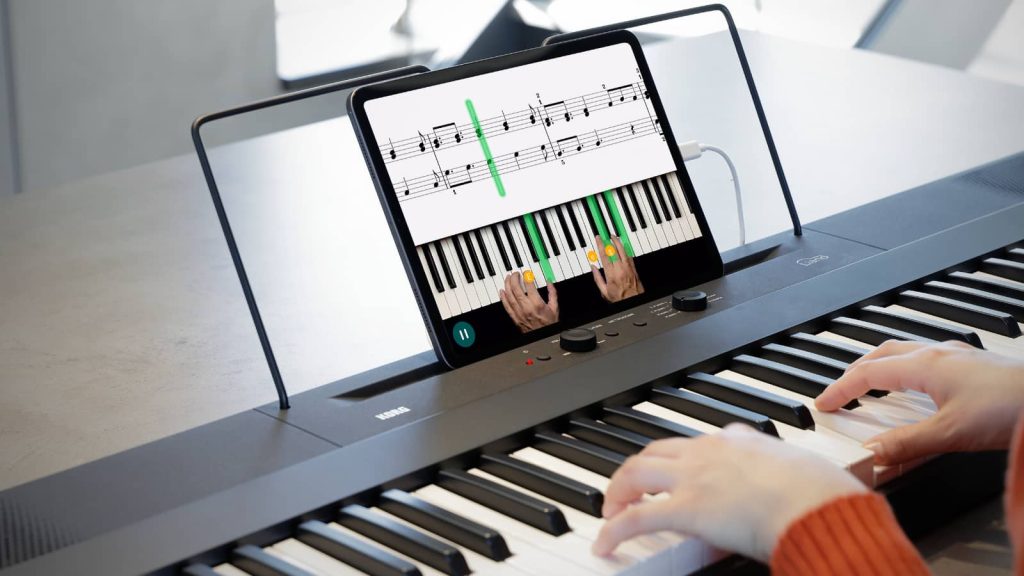
Online lessons with Skoove and Korg Liano - thanks to USB audio/MIDI, the connection between electric piano and tablet is very easy to establish. (Image Source: Korg & More)
Online lessons with Skoove and Korg Liano - thanks to USB MIDI/Audio, the connection between electric piano and tablet is easily established. (Image Source: Korg & More)

The Korg Liano is a particularly lightweight stage piano (approx. 6 kg) thanks to its compact body and easy-to-play semi-weighted keyboard. If mobility is a priority, this is the 88-key stage piano for you.

Pros and Cons

  • Lightweight and compact
  • USB MIDI/Audio function
  • Powered by batteries
  • Casing could be more durable

Jörg Sunderkötter

→ REVIEW

...a tip for anyone who wants to practice the piano or take online lessons while on the go, or needs an extremely compact and lightweight digital piano for rehearsal, small gigs and live jams.

Liano :   310,00 €

TO THE OFFER

Korg B2

You are currently viewing a placeholder content from YouTube. To access the actual content, click the button below. Please note that doing so will share data with third-party providers.

More Information

If you prefer a weighted hammer-action keyboard, look no further than this portable piano from Korg. Its minimalist sound equipment basically suggests adding sounds from a piano app.

Jörg Sunderkötter

→ REVIEW

The USB audio/MIDI functionality makes the Korg B2 a flexible digital piano for beginners and entry-level players who also want to learn and play the piano in connection with a smartphone or tablet.

Thomann SP-120

Would you prefer a slightly smaller keyboard and a more compact case? Despite its semi-weighted keys, the Thomann SP-120 is very comfortable to play and has a powerful sound system. It’s recommended for anyone looking for a lightweight, compact, portable piano.

Pros and Cons

  • Lightweight and compact
  • USB audio/MIDI function
  • Good speaker system
  • Price/performance
  • USB audio not adjustable

Jörg Sunderkötter

→ REVIEW

The only notable trade-off with the SP-120 is the smooth playing feel of its semi-weighted keyboard. However, this design choice keeps the weight down, making the SP-120 an ideal mini piano for travel.

SP-120 :   169,00 €

TO THE OFFER

Roland FP-30X

You are currently viewing a placeholder content from YouTube. To access the actual content, click the button below. Please note that doing so will share data with third-party providers.

More Information

This portable piano offers the most comprehensive features of this selection and generally features one of the best keyboards in its price range.

Pros and Cons

  • Many modern features
  • USB MIDI/Audio
  • Quality keyboard
  • Quality piano sounds
  • Tiny footswitch as a sustain pedal

Jörg Sunderkötter

→ REVIEW

The smaller model of the new FP-"X" Series is a powerful stage piano for home and mobile use thanks to its great features at an attractive price. The FP-30X has modern features, including MIDI and audio Bluetooth and USB connections; greatly expanded sound generation; new speaker settings; and app connectivity for iOS and Android devices. The keyboard and piano sounds are impressive, as is the overall sound selection.

FP-30X BK :   599,00 €

TO THE OFFER

FP-30X WH :   621,00 €

TO THE OFFER

DP-10 :   45,00 €

TO THE OFFER

Studiologic Numa X

studiologic-numa-x-usb-audio-midi
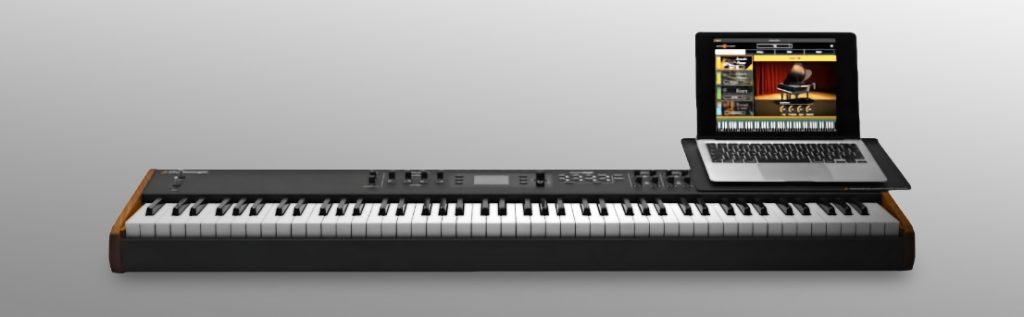
A USB connection allows for the digital transfer of the audio signal from the laptop to the Studiologic Numa X audio system. Studiologic offers an optional laptop holder for the Numa X 88 and Numa X GT models. (Image Source: Studiologic)

A professional stage piano with MIDI keyboard features, the Studiologic Numa X comes with many great sounds and effects. USB MIDI/Audio allows connections to mobile devices. The Studiologic Numa X is available in several different keyboard versions.

Jörg Sunderkötter

→ REVIEW

The range of features is as impressive as the consistently vibrant and powerful 200 internal sounds.

Numa X Piano 88 :   1.299,00 €

TO THE OFFER

Numa X Piano GT :   1.699,00 €

TO THE OFFER

Numa X Piano 73 :   1.049,00 €

TO THE OFFER

What Can You Do with USB MIDI/Audio?

Whether you want to learn the piano with an app, play along with songs, take online lessons, create music with a DAW app, or use your iPad as a piano module, USB MIDI can make it happen. Almost all digital pianos have this feature nowadays, so why is there a need for more?

Problem #1:
When connecting a digital piano to mobile devices via USB MIDI, you are working with two separate audio systems: While you hear the digital piano through its built-in speakers or headphones, the piano app plays through the iPad’s connected speakers or headphones.

As you can see, this requires mixing two separate audio signals. You can either connect the iPad and the digital piano to a mixer, or connect the iPad’s audio output to the digital piano’s audio input. With these connection options come the next problems…

  • Problem #2: New iOS devices no longer have analog audio outputs.
  • Problem #3: Not all digital pianos have audio inputs.
  • Problem #4: Even if all analog connections are available, using the Camera Connection Kit with audio cables and power supplies can create ground loops that require a DI box to eliminate.

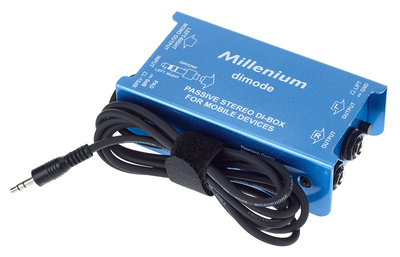
If your digital piano supports USB MIDI/audio, you can save money on accessories and eliminate cable clutter. If your piano only has USB MIDI and an audio input, the “dimode” stereo DI unit by Millenium is a good choice.

Affiliate Links
Millenium dimode
Millenium dimode
Customer rating:
(59)

USB MIDI/Audio Function – FAQ

It’s very easy to connect a digital piano to an iPad using the USB MIDI/Audio function. Below are a few technical details that may be helpful, depending on your equipment.

Why not use Bluetooth instead?

A USB cable connection contrasts with wireless Bluetooth, the easiest option for using a remote piano app or playing along with a song. Bluetooth works perfectly well in cases where only MIDI or audio data is needed.

However, if you need to transmit both audio and MIDI at the same time, a USB connection is essential. The reason is that Bluetooth audio always introduces a slight delay. This latency is too high to keep MIDI and audio in sync.

What does MIDI stand for?

MIDI stands for Musical Instrument Digital Interface. This is a standardized interface that was agreed upon by a committee of musical instrument manufacturers in the 1980s. The purpose of MIDI is to connect musical instruments within a network. This allows you to trigger the sequencer of a DAW program or, for example, a music notation program via a synthesizer or electric piano, and vice versa.

MIDI only carries control information, such as which keys are played, how long they are played for, and their velocity. However, the MIDI protocol also transmits control panel information, such as sound selection, and other functions, such as pedals. These functions are listed as standardized information and are called program change, pitch bend, or continuous controller (volume, expression, timbre, sustain, etc.).

What is USB MIDI?

Originally, a MIDI connection was established using a MIDI cable with round, five-pin DIN connectors. However, these connections have almost entirely been replaced by USB connections. Technically, USB can do even more, but almost all electric pianos use the USB port for the USB-MIDI connection.

Piano remote apps use the MIDI protocol to control the piano and its functions remotely via a touch screen. MIDI data is not very data-intensive and is transmitted quickly over USB-MIDI, resulting in virtually zero latency.

What is USB Audio?

USB audio interfaces are well-known for their ability to transfer digital audio information. In principle, this requires a driver architecture, but this is not necessary for digital pianos with USB MIDI/Audio functionality. It’s similar to audio interfaces that meet the “class-compliant” standard, which are immediately supported by the operating system via plug-and-play.

Which USB port is the right one?

Every digital piano today has a USB port. However, some models even have two.

  • USB to Host: This port is used to connect to computers, tablets, and smartphones, and to transfer USB MIDI and USB audio data.
  • USB to Device: This port allows you to connect external storage devices, such as USB flash drives, as well as special hardware, like the Casio Bluetooth Adapter WU-BT10.

What is a DI unit?

The acronym stands for Direct Injection. A DI unit is a small accessory used in recording studios to convert unbalanced signals into balanced ones. This conversion occurs through a transformer that galvanically isolates the circuits, thereby eliminating ground-loop hums caused by interconnected devices with separate power supplies.

Using mobile devices or computers with electric pianos or mixing consoles can cause noise due to the presence of multiple power adapters. There are active and passive DI boxes. Passive DI boxes do not require their own power source and typically result in a lower output level, which the mixing console compensates for with the head amplifier. Active DI boxes have an internal amplifier circuit and deliver a better output level. A 2-channel DI box is required to transmit the stereo audio signal from mobile devices.

*Affiliate link. These “advertising links” help us finance our website. If you purchase a product through one of these links, we receive a small commission at no additional cost to you. The PIANOO.com team thanks you for your support!

ADVERTISEMENT

Related Articles

01.04.2025 · Play Yamaha DX7: The FM Piano Sound of the '80s

Everyone knows the bell-like, cool FM piano sound, often enhanced with effects and found in nearly every digital piano. This sound was modeled after the legendary Fender Rhodes but has a much brighter, more artificial ...

22.02.2025 · Learn Piano Chords: Adele - Someone Like You

You don't have to be a professional pianist to play the piano chords for the song Someone Like You. And yet it is one of Adele's most successful songs. In that sense, Someone Like You ...

19.02.2025 · Play Giveaway – Win Pianoteq Stage, Standard or PRO!

In our "PIANOO Giveaway", Modartt is offering three full user licenses for Pianoteq. This physically modeled software instrument runs on MacOS, iOS, Windows, and Linux. You have the chance to win a license for one ...

27.01.2025 · Play Behind The Passion - The Thomann Story

70 years of Thomann - 70 years of passion for music. Under the title Behind the Passion, the music store tells the story of Thomann and offers a closer and more personal look behind the ...

13.01.2025 · Buy Kawai ES Series: ES-920, ES520, ES-120, ES-60 – Portable Pianos

Kawai's ES Series portable pianos are popular with both beginners and advanced players, offering high-quality features in the $400–$1,200 price range. Key improvements over previous ES models include a significantly lighter weight, bass reflex speakers, ...

13.01.2025 · Play Piano Day - March 29, 2025

Why does the world need a Piano Day? "There are many reasons," says Nils Frahm, "but above all, it can't hurt to celebrate the piano and everything related to it: Artists, composers as well as ...

10.01.2025 · Play Free DAW Software: No-Cost Audio/MIDI Sequencers

Since not every piano VST is available as a standalone version, you need host software. If you don't want to buy an expensive digital audio workstation, you can use a free DAW instead. And you ...

07.01.2025 · Play Superbooth 2025 - Electronic Music and Instruments Festival

Save the Date! Superbooth 2025 will take place from May 8-10. This year, too, you can look forward to the performance and workshop program, which invites you to the usual location at the Freizeit- und ...

05.01.2025 · Play How to Connect a Stage Piano to a PC: MIDI, USB, Bluetooth

If you want to record authentic piano tracks in a DAW, you need a good MIDI keyboard. Of course, you can also connect a digital piano or stage piano to your PC instead. Depending on ...

11.10.2024 · Play Felt Piano: A Softer Piano Sound

The term "felt piano" is closely associated with the popularity of the neoclassical genre, where this very soft sound has almost become a trademark. The sound and its poetic quality are actually a by-product of ...

10.10.2024 · Play Playing Piano with the Sustain Pedal: Sustain Notes Correctly

Playing piano with the sustain pedal - it's the easiest thing in the world! Full-throttle on the right pedal and hammer on the keys - it's great fun and sounds excellent. However, getting from one ...

14.08.2024 · Play What Is a "Triple-Sensor Digital Piano"?

You'll find the term triple sensor, 3-sensor, or tri-sensor technology in the specifications of many digital pianos. But is a triple-sensor digital piano really better, or can you safely ignore this feature? A brief look ...