ADVERTISEMENT

Review: Casio PX-S3100 – Portable Piano with Auto Accompaniment

  • The PX-S3100 is the successor to Casio’s PX-S3000.
  • Unlike its more streamlined sibling, the PX-S1100, the PX-S3100 offers an extensive selection of sounds and built-in auto accompaniment.
  • Although the design is the same as the previous model, the PX-S3100 features an upgraded sound and adds Bluetooth support for audio and MIDI.

Pros and Cons

  • Extensive features
  • Many sounds and styles
  • Great piano sound
  • Ivory Feel keytops
  • Simple footswitch as a sustain pedal
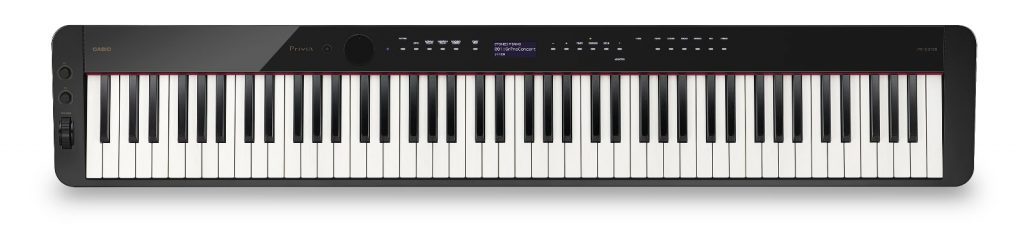
Casio PX-S3100 – Portable Piano with Auto Accompaniment (Image Source: Casio)
(Image Source: Casio)
ADVERTISEMENT

After two years, Casio has released a successor to its popular Privia PX-S3000 arranger piano. With the Casio PX-S3100, you get a solid digital piano, a broad selection of sounds and a surprisingly capable auto-accompaniment system, all at an entry-level price.

ADVERTISEMENT
ADVERTISEMENT
Undoubtedly one of the best keyboards available in this price range.

The PX-S3100 looks identical to its predecessor. At first glance, someone unfamiliar with the model might mistake this sleek, compact instrument for a MIDI controller keyboard rather than a full-featured arranger piano. However, with 700 built-in sounds and 200 accompaniment styles (referred to as “rhythms” by Casio), the S3100 is very much an arranger piano geared toward beginners. Like the PX-S3000, it carries a moderate list price of $1,179 (£839/€949) and is often available for less at retail.

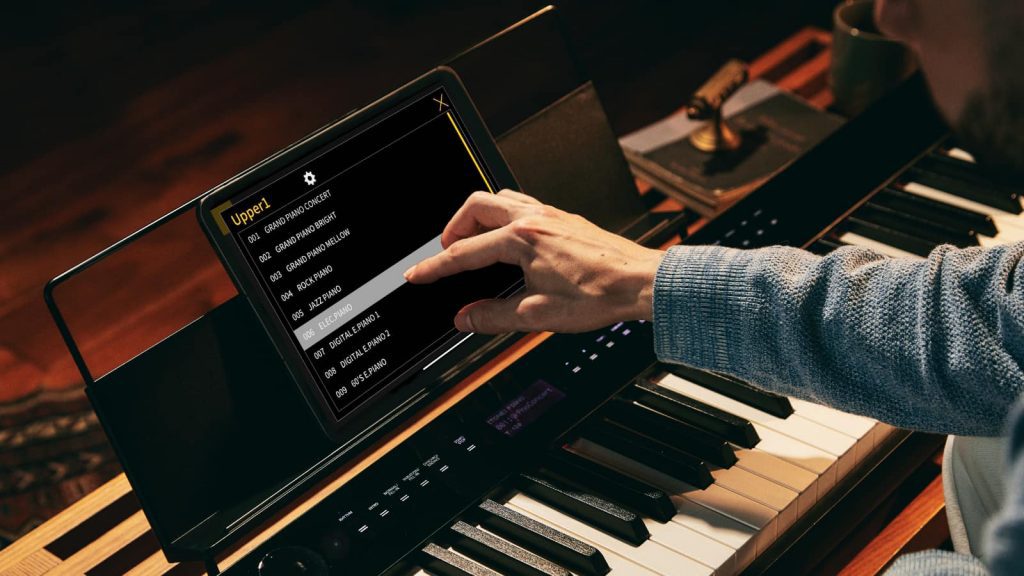
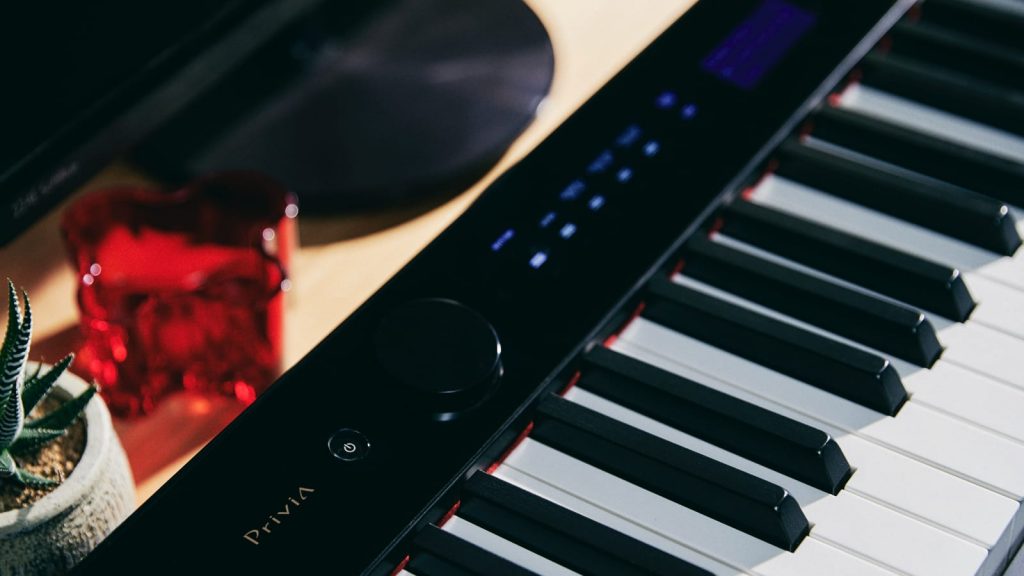
Casio has once again employed its signature trick of setting a clear plastic panel into the case to create a glossy finish on the user interface. Like its smaller sibling, the PX-S1100, the S3100 has minimal physical controls: Just a power button, a volume knob, and a set of illuminated touch buttons. However, new to the S3100 is a three-line LCD display that shows all digital piano functions. This eliminates the need to use the keyboard itself for navigation.

Despite its beginner-friendly appearance, the PX-S3100 has an extensive set of features. This means that navigating certain submenus may require some practice and a close look at the manual. Please note that the full manual is only available as a download from the Casio website; the instrument itself only comes with a quick start guide.

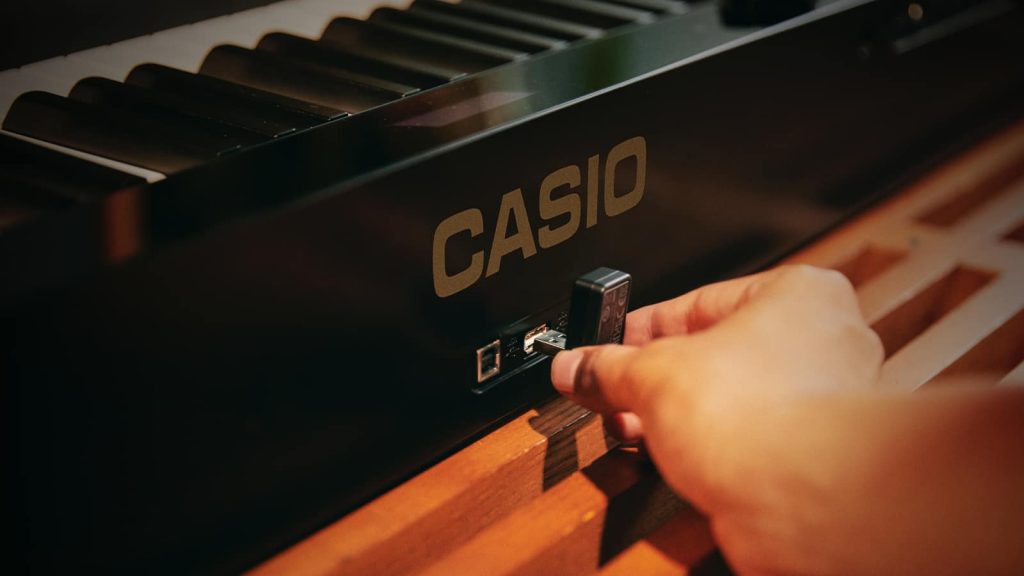
Included with the instrument are an external power supply, a sheet music stand, the SP-3 footswitch, and—new to this model—the WU-BT10 Bluetooth adapter. It’s fun to start playing right away, but given the quality of the grand piano sound and the keyboard action, many players will soon wish for a more responsive sustain pedal. Casio offers optional upgrades here: the SP-20 single pedal and the SP-34 three-pedal unit. The matching CS-68 stand is also available as an accessory. For portable use, the S3100 can run on six AA batteries, giving you around two hours of playing time away from a power outlet.

Good Playing Feel

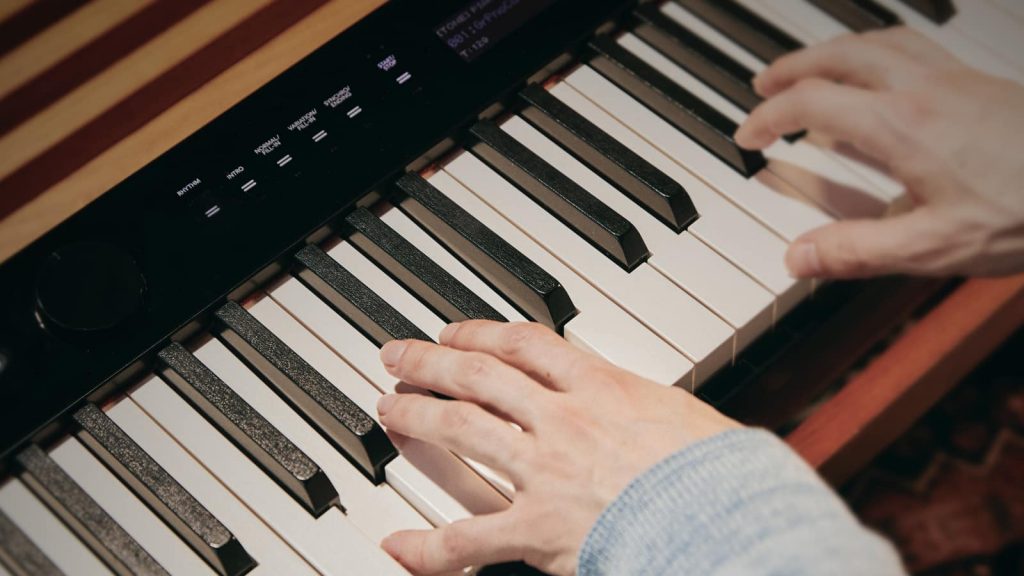
The PX-S3100 features the same 88-key keyboard as its predecessor and the PX-S1100. Despite the relatively short key length due to the compact stage piano design, the playing feel is impressively satisfying. The keys are well balanced, and the graded hammer action is clearly perceptible. Alongside its good repetition response, the textured key surfaces provide a secure, comfortable grip. In this price range, it’s undoubtedly one of the best keyboards available. Five velocity curves let you tailor the touch sensitivity to your playing style.

Thanks to its synthetic ivory and ebony key surfaces, this keyboard is one of the best in its price range. (Image Source: Casio)

Piano Qualities of the PX-S3100

As a digital piano with arranger functions, the Casio PX-S3100 offers a wide variety of sounds. For now, let’s focus on its piano capabilities: Casio’s acoustic pianos are definitely among the best in the entry-level category.

The three core sounds “Grand Piano Concert,” “Grand Piano Bright,” and “Grand Piano Mellow” are all based on the same high-quality multisample and deliver impressive realism. Features such as string resonance, damper resonance, and even mechanical and key-off noise from an acoustic grand are not only present but can also be fine-tuned via the “Acoustic Simulator” menu. According to Casio, the multisamples are not identical. This results in an overall piano tone that is slightly more refined than that of the PX-S1100. In direct comparison, the S3100’s grand piano sound is even more lifelike when played dynamically and expressively.

Beyond the main piano voices, the “Piano” category contains 28 additional sounds suited to various genres, including jazz, pop, rock, and dance. Further, there are ambient pianos with extended reverb or delay, as well as layered variants with strings or synth pads. The latter do not require manual use of the layer function. The bank also features vintage tones inspired by Yamaha’s CP-70/80 electric grands, as well as convincing harpsichord sounds complete with key-off samples. Like its predecessor, the PX-S3100 boasts 192-note polyphony.

The display makes navigating the piano intuitive and straightforward, while the free Chordana Play for Piano app adds even more convenience and functionality. (Image Source: Casio)

Privia Power: Sound Variety

You can access five additional sound categories directly via the user interface: E. Piano, Organ, Strings, Pad, and Others. From the start, it’s clear that Casio is aiming to impress with a strong emphasis on vintage sounds and pad textures—and the PX-S3100 delivers convincingly. There’s a generous selection of high-quality Fender Rhodes, Wurlitzer, and FM electric pianos; Hammond B3, home, and pipe organs; as well as lush natural and synthesized string sounds, not to mention a wide range of pad layers.

Two onboard effects processors significantly enrich the sound palette: They offer tremolo, wah-wah, phaser, and flanger for electric pianos as well as rotary speaker simulation and distortion for organs. There’s also a wide range of modulation and amp effects for other sounds. For a keyboard in this price range, the level of sonic detail is well above average.

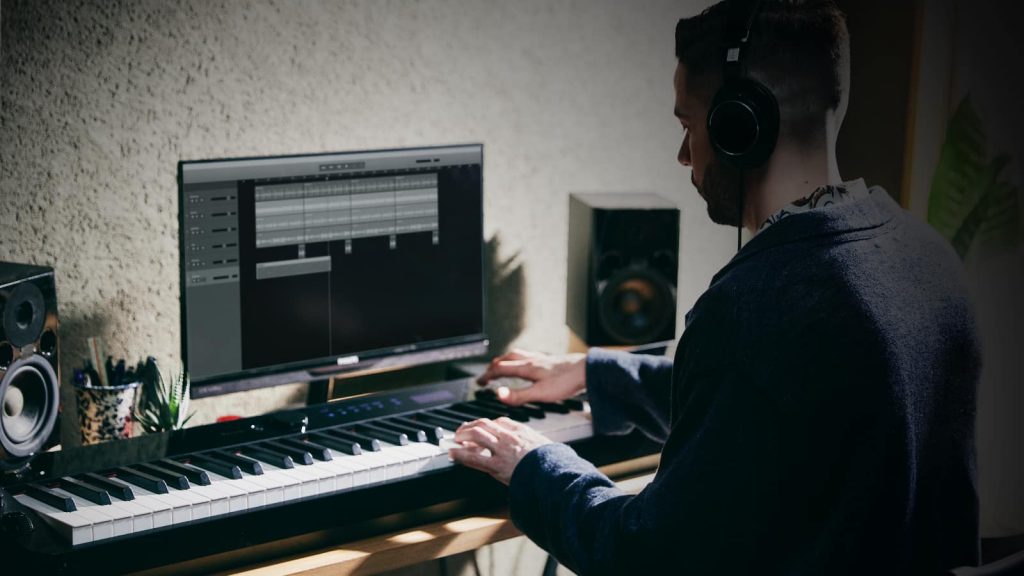
Lead synths, guitars, basses, 128 GM sounds, and 31 drum and percussion kits complete the sound palette. Overall, the PX-S3100 is an excellent choice for musicians seeking a digital piano well-suited for MIDI recording and production.

Performing with Sounds on the Casio PX-S3100

To bring more expression to synth sounds, the PX-S3100 features a pitch bend wheel and two knobs. Fourteen predefined “knob sets” allow you to adjust various parameters, including filter cutoff, resonance, vibrato rate, and depth. Some sets also include controls for functions like keyboard volume and arranger balance.

You can split and layer all sounds freely, with independent volume controls for both the lower and upper parts. You can also adjust effects and pedal functions individually and, once configured, save your setup as a registration. A generous 96 memory slots are available for this purpose.

Unfortunately, you cannot label the registrations with custom song or set names. Instead, they are organized into banks of four and given generic names, such as “Bank 1, Area 2” or “Bank 3, Area 4.” To keep track of your custom setups, it’s best to maintain an external list of what each registration contains.

Speaker System

With 16 x 8 cm oval speakers and 8 watts of power per channel, the built-in amplification system is well-suited for home use. Thanks to its front and rear sound projection, the system delivers clear, transparent, and surprisingly full sound for its size. For further experiments, there is the “Sound Mode” function, which simulates a surround sound effect, and the brilliance control. While the placement of the instrument also affects the perceived sound, the PX-S3100 naturally sounds even better when you connect it to a more powerful external speaker system.

While there is no dramatic leap in speaker performance compared to the previous model, Casio notes that the internal speakers have been slightly upgraded and that the interaction between the piano sound engine and the onboard amplification has been further refined.

A powerful digital piano that's also perfect for your home studio. It connects to your computer via USB or wirelessly via Bluetooth. (Image Source: Casio)

Let Me Entertain You

The PX-S3100’s built-in automatic accompaniment feature was adapted from Casio’s line of portable keyboards. Dedicated touch-sensitive controls to the left of the display control the arranger for quick access to the most frequently used functions.

Casio refers to its styles as “rhythms,” which are kept fairly straightforward. Each rhythm includes an intro, ending, and basic and variation versions of the accompaniment patterns, each with a matching fill-in. There is a wide range of appealing arrangements available, covering pop, rock, dance, Latin, jazz. A selection of classic ballroom styles rounds out the collection, including waltz and foxtrot, as well as several well-crafted, piano-driven ballads.

Unfortunately, there is no region-specific version of the PX-S3100. This means that the style selection is intended to have global appeal and includes many rhythms that may not resonate with all players. Still, given the instrument’s price, many will find this trade-off acceptable.

Music at the Touch of a Button

Each rhythm style comes with a matching One Touch Preset that provides an appropriate sound setup. Additionally, 310 music presets offer genre-specific chord progressions.

The Song section supports 16-part multitimbrality. Combined with the built-in GM sound set, it enables playback of General MIDI files. You can record your own performances with or without accompaniment across three internal tracks (one system track and two solo tracks).

For audio recording, you. must save your performances directly to a USB drive in WAV format. You can also play back WAV audio files from the USB stick.

To connect the WU-BT10 Bluetooth adapter, plug it into the USB-to-Device port. (Image Source: Casio)

Casio PX-S3100 in Comparison

PX-S3100 vs. PX-S1100: The PX-S1100, priced around $200 less, is essentially a streamlined, pure piano version of the PX-S3100. It offers 18 sounds, including Casio’s three flagship grand pianos. However, it lacks auto accompaniment, DSP effects, registration memory, assignable controllers, and General MIDI compatibility. As a digital piano, though, the PX-S1100 performs almost as well as its more feature-rich sibling. While it supports audio playback and Bluetooth app connectivity, its onboard control interface can feel limited unless you use the Casio Music Space app.

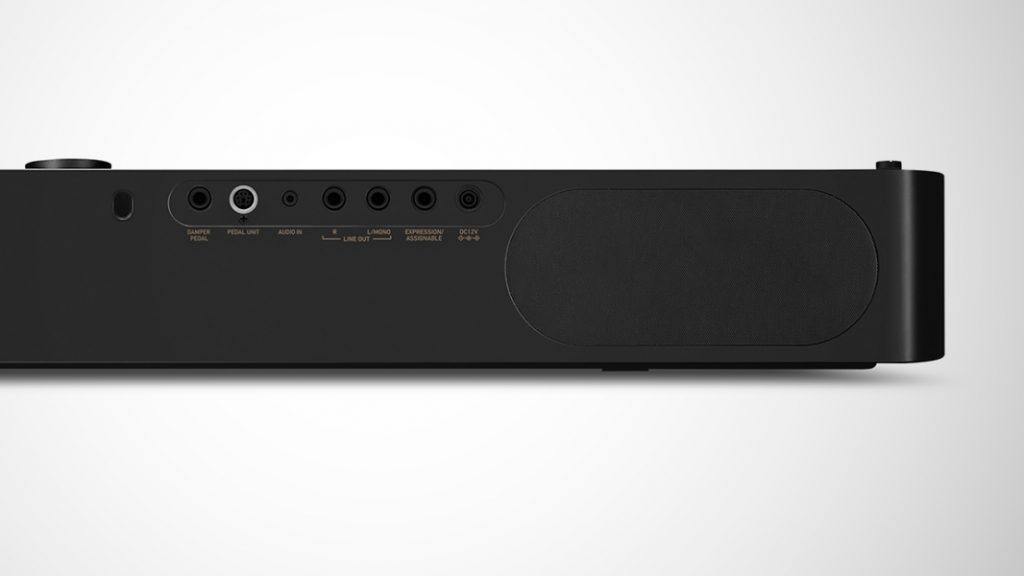
As you'd expect from a quality portable piano, the connectivity options are comprehensive: stereo line-out (¼" jacks), inputs for sustain and expression pedals, USB-to-Host, USB-to-Device, and a stereo mini jack audio input for mobile devices. (Image Source: Casio)

Conclusion: Great Sound and Playing Enjoyment Guaranteed

Like its predecessor, the PX-S3100 is a fantastic, ultra-slim portable piano that delivers excellent sound and a high-quality keyboard feel for its price range. With 700 onboard sounds, a built-in arranger, and versatile song player/recorder features, it offers exceptional value and is genuinely enjoyable to play.

That said, there are only minor updates compared to the PX-S3000. The improvements to the internal speaker system and the acoustic piano sound are subtle. The only notable addition is the Bluetooth adapter, which now supports both wireless MIDI and audio. According to Casio, it’s not compatible with the PX-S3000—likely because that model already includes built-in Bluetooth audio functionality.

Casio PX-S3100

Casio PX-S3100 – Overview

Release date: October 2021
Keyboard: 88 keys, Smart Scaled Hammer Action
Polyphony: 192 voices
Sound generation: Sampling
Included: Power supply, music stand, sustain foot switch
Piano app: Casio Music Space (Android, iOS), free
Manufacturer/Distributor: Casio

Pros and Cons

  • Extensive features
  • Many sounds and styles
  • Great piano sound
  • Ivory Feel keytops
  • Simple footswitch as a sustain pedal

Henrik Bruns

With 700 onboard sounds, a built-in arranger, and versatile song player/recorder features, it offers exceptional value and is genuinely enjoyable to play.

PX-S3100 BK Privia :   699,00 €

TO THE OFFER

SP-34 Sustain Pedal Unit :   69,00 €

TO THE OFFER

CS-68 PBK Privia Stand :   115,00 €

TO THE OFFER

PX-S3100 BK Privia :   699,00 €

TO THE OFFER

SP-34 Sustain Pedal Unit :   69,00 €

TO THE OFFER

CS-68 PBK Privia Stand :   115,00 €

TO THE OFFER
ADVERTISEMENT

Bluetooth MIDI · Casio · Digital Piano · Digital Piano under 1000

Review

ADVERTISEMENT

Related Articles