ADVERTISEMENT

What Are Piano Pedals For?

  • Piano pedals enhance the expressive capabilities of an upright, grand, or digital piano. Using the pedals requires some skill.
  • Three pedals for sustain, soft, and sostenuto functions are standard on both acoustic and digital pianos.
  • Smaller pianos often have only two pedals. Even with three pedals, the functionality differs from that of an acoustic grand piano.
Piano pedals: The standard functions are sustain, sostenuto, and soft.
ADVERTISEMENT

Whether you play a grand, acoustic, or digital piano, three piano pedals are the norm. There are many variations and extraordinary ways to express yourself with the pedals, especially on acoustic pianos. But what is each piano pedal for and how do you use them?

ADVERTISEMENT
ADVERTISEMENT
The function of pedals can vary greatly, especially on digital instruments.

With the invention of the fortepiano by Bartolomeo Cristofori, a 17th-century piano maker, pedals expanded the expressive possibilities of piano playing. While the first fortepianos allowed dynamic playing, they, like the harpsichord, lacked pedals. Instead, the keyboard and action were more important.

The sustain pedal on the piano creates a remarkable effect: The full sound of the resonating strings and soundboard is perhaps the most characteristic element of piano sound. However, the piano pedals allow for many other expressive possibilities that have had a lasting influence on piano playing: From the deliberate use of certain string resonances in the sostenuto pedal and string harmonic-like tones to the felt piano sound in the neo-classical style.

Piano Pedal Functions in Simple Terms

The pedals can actually perform various functions, especially on digital instruments. Many digital pianos, stage pianos, and MIDI keyboards with piano keys allow you to customize the pedal functions. However, the basic Soft, Sostenuto, and Sustain functions will always be the default preset. Portable and stage pianos include at least one sustain pedal (damper) as an accessory. Moreover, sustain pedals are available as additional accessories in various quality and price ranges.

There are several things to consider when purchasing a sustain pedal. You can learn more about this in the guide “Buying a Digital Piano Pedal” on PIANOO.com.

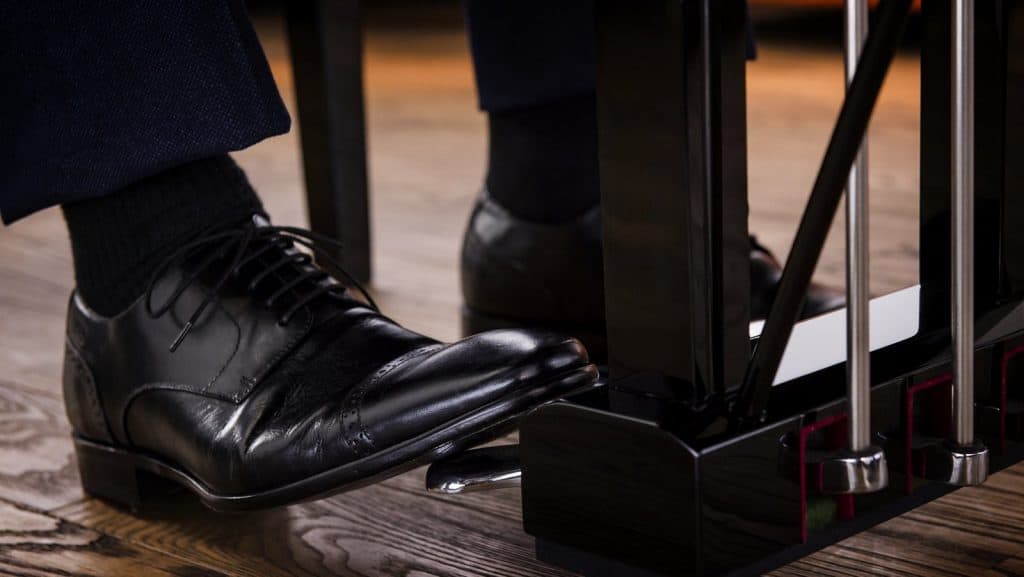
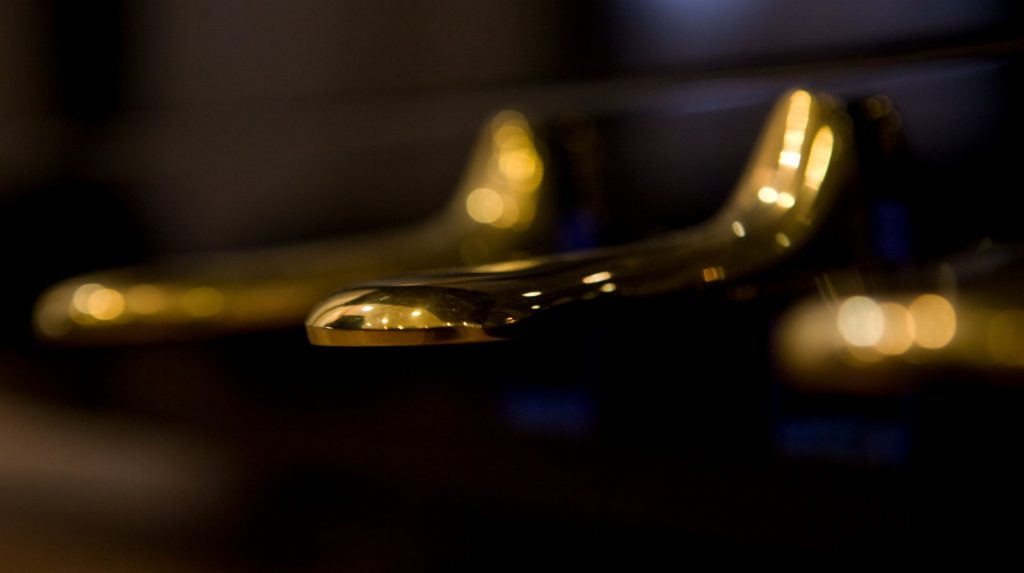
On acoustic pianos, the function of the pedals varies from model to model. The most obvious difference between an upright piano and a grand piano is that the pedals on an upright piano are integrated into the case of the piano. On a grand piano, however, the pedals are attached to a special element called the lyre. Piano pedals are typically made of brass, although other materials may also be used.

In upright pianos and pianos, you’ll find the action inside the piano. The vertical arrangement of the strings and soundboard not only results in a keyboard mechanism different from that of a grand piano but also in a different pedal mechanism.

Sustain Pedal Half Pedal
(Image Source: Yamaha)

The Right Pedal – Sustain

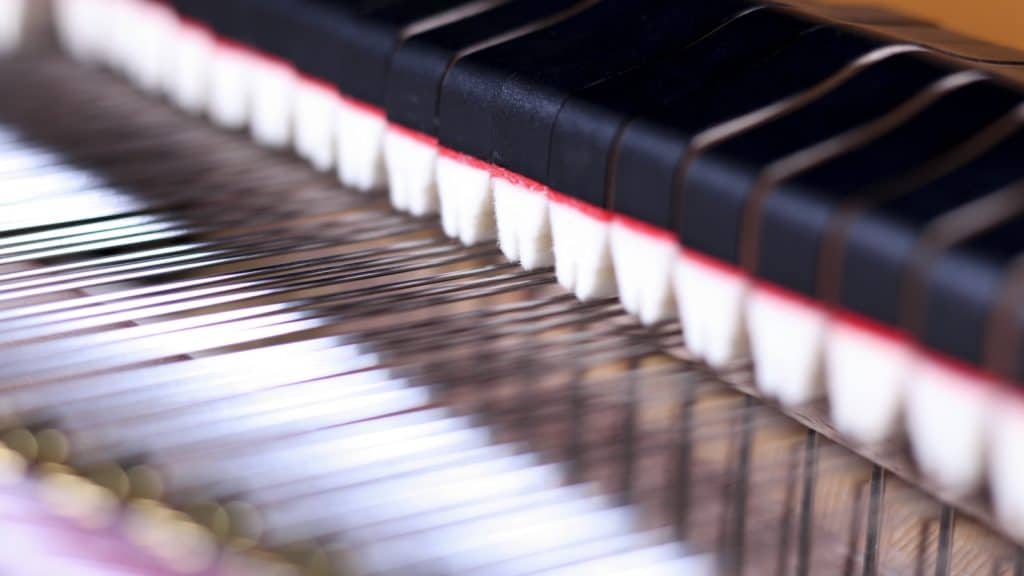
The right pedal is probably the one you use most often – its function is the same on all pianos: The right pedal simultaneously lifts all dampers from the piano strings. This allows the strings to vibrate freely and produce a rich, resonant sound that interacts with the soundboard. This pedal is also known as the sustain, loud, damper, or open pedal.

When the damper pedal is depressed, even a single note sounds very full as the strings of other notes resonate with it. This effect is particularly noticeable in strings that share harmonic relationships within their overtones, known as sympathetic resonance. While this makes it similar to a reverb effect, sympathetic resonance produces a less diffuse sound.

The term “loud pedal” probably comes from the amplifying effect: The sound grows louder and gains more depth. Using the damper pedal requires a certain amount of skill. If you exaggerate the effect, the resulting sound will quickly become blurred – especially if you hold down the damper pedal during chord changes.

Learn more: Playing with Damper Pedal: Using Sustain Properly.

The damper pedal lifts the dampers of all notes off the strings at once, leaving the strings free to vibrate. The dampers leaving the strings can produce a diffuse noise known as damper noise. (Photo: Jörg Sunderkötter)

The Damper Pedal: Half-Pedaling, Repedaling, String Harmonics

You use the damper pedal to control the duration of the note: The harder you press the pedal, the more the strings are released. Pressing the pedal only halfway down extends the note only slightly. The technique to achieve exactly this effect is known as half-pedaling. It sometimes makes it a little easier to play difficult passages of tied notes. Even mid-range digital pianos support half-pedaling.

Repedaling is a special feature of acoustic pianos that digital pianos simulate more or less well. On a grand piano, you will notice a slight increase in volume even if you depress the pedal after already playing a note or chord. While many digital pianos ignore this rather subtle effect, most instruments allow for repedaling, which is made possible by the mass inertia of the strings.

Playing string harmonics is a special kind of pedal technique that makes use of the strings for a very short time. With the dampers only briefly on the strings, it is still possible to release a certain amount of “residual vibration” with the damper pedal, provided you depress it quickly enough. Depressing the damper pedal very quickly after playing staccato notes then lets you produce string harmonic-like sounds with the piano. Therefore, when you depress the damper pedal again, you will hear partials of the note you just played. While this can be difficult to reproduce electronically, the physical modeling piano software Pianoteq does it surprisingly well.

The Middle Pedal – Sostenuto

Sostenuto is the standard function for this pedal, at least on a grand piano. On some pianos, however, the middle pedal also operates as a damper pedal. The true sostenuto function is similar to the damper pedal but only affects the notes you play, making it a kind of selective sustain function.

Some piano literature also requires sostenuto for resonance purposes, so sympathetic resonance becomes a compositional device here. In this scenario, you press the keys without sounding the notes and then sustain them using the sostenuto pedal. Since only the dampers of these notes remain raised, their strings resonate when you play other ranges. In contrast to the damper pedal, the resonance effect here is very differentiated. You can even play other notes in staccato as usual, or optionally combine the sostenuto with the damper pedal.

The Practice Pedal: A Softer Sound

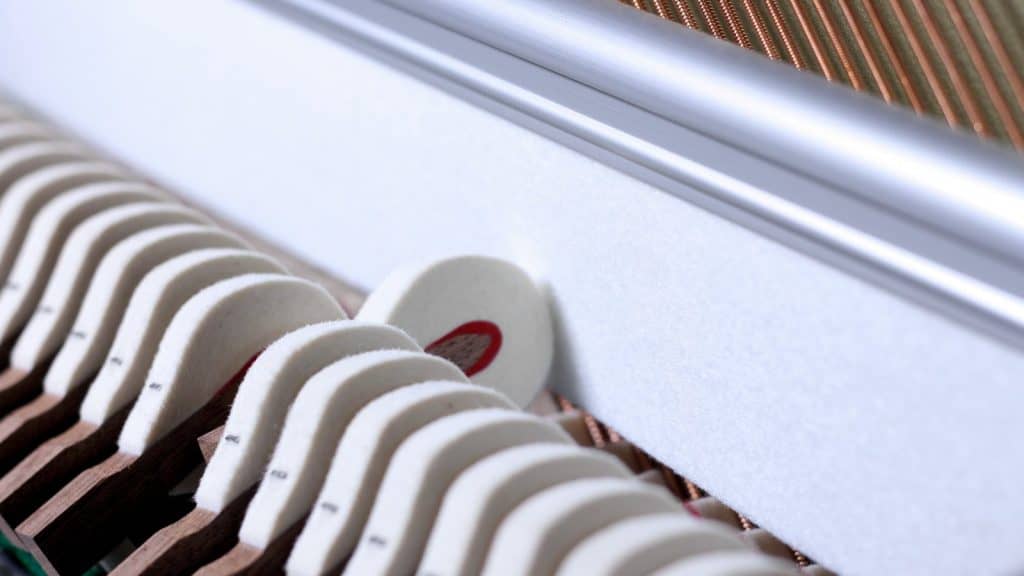
This function is often used in conjunction with the damper pedal on a piano. The practice pedal dampens the attack by placing a strip of felt between the hammers and the strings. In most cases, you can even move the practice pedal sideways to secure it in the depressed position for permanent use. The dampening effect of the felt strip produces a very soft, almost muffled sound. While the practice pedal affects the sound quality, it also allows you to practice quietly on an acoustic piano.

You can also use the practice pedal musically to intentionally soften the tone. In this context, the term “felt piano” is used to describe a piano that has been “prepared” with the practice pedal. Many neoclassical and film music piano recordings use this atmospheric sound to emphasize the mechanical sounds of the piano. In general, the more intimate and immersive the sound, the better.

Practice Pedal - Damping the Hammers with a Felt Rail
The practice pedal places a felt rail between the hammers and the strings, creating a very soft touch.

The Left Pedal – Soft

The left pedal is also known as the soft pedal, which already describes its function well. The soft pedal allows for a gentler touch and even softer pianissimo passages. It achieves this by mechanically reducing the distance between the hammers and the strings. As the key action is processed differently, a wider pianissimo range becomes available.

On a concert grand, the left pedal is also called the una corda pedal. Depressing this pedal shifts the entire action of the keyboard and hammers by a few millimeters. As a result, the hammers can only strike two piano strings – the third string of the string section now resonates passively. All in all, using the soft pedal results in a special grand piano sound, which is less intense and more restrained. The una corda sound is also an interesting variation of the piano sound in terms of attack and decay.

Soft Pedal on Digital Pianos

The soft pedal on most digital pianos is nothing more than a simple auxiliary function: It usually softens the sound by muting the overtones, which is not quite true compared to the acoustic model. Above all, it is in no way comparable to playing una corda on a grand piano. On a digital piano, the sound remains brilliant while the dynamic range shifts to a different volume and offers special articulation possibilities.

From a technical point of view, piano sampling must take into account an una corda sample, i.e. the grand piano must be sampled in all tonal and dynamic ranges of the una corda. However, while digital pianos rarely take this into account, some software pianos allow realistic una corda playing, e.g. Modartt Pianoteq.

Differences Between Acoustic and Digital Pianos

Acoustic pianos use mechanical pedals, while digital pianos use electronic pedals. The advantage of the latter is that digital systems allow you to assign multiple functions to pedals, such as turning the pages of sheet music, switching effects, etc.

Learn more about digital piano pedals in this PIANOO.com guide: Buying a Digital Piano Pedal.

More elaborate hybrid digital pianos, however, incorporate more mechanical components, although these are more or less intended to create an authentic simulation. After all, the transmission of the action to the sound generator is entirely electronic. In this context, you’ll hear terms such as “GP Response Damper Pedal” or “Specialized Grand Piano Pedal”, which refer to the simulation of the half-pedal function achieved by continuously moving the damper pedal.

Similarly, damper noise requires dynamic pedal control. You’ll also find this function on more expensive digital pianos only. In contrast, inexpensive entry-level digital pianos usually use simple pedals that can only transmit two states (on/off) electronically. This makes half-pedaling and damper noise impossible.

Learn More About the Functions of Piano Pedals

Half-Pedaling: Half-Pedal Function on Pianos and Digital Pianos
Damper Noise and Damper Resonance

Discussions on pianoworld.com

*Affiliate link

ADVERTISEMENT

Related Articles

01.04.2025 · Play Yamaha DX7: The FM Piano Sound of the '80s

Everyone knows the bell-like, cool FM piano sound, often enhanced with effects and found in nearly every digital piano. This sound was modeled after the legendary Fender Rhodes but has a much brighter, more artificial ...

22.02.2025 · Learn Piano Chords: Adele - Someone Like You

You don't have to be a professional pianist to play the piano chords for the song Someone Like You. And yet it is one of Adele's most successful songs. In that sense, Someone Like You ...

19.02.2025 · Play Giveaway – Win Pianoteq Stage, Standard or PRO!

In our "PIANOO Giveaway", Modartt is offering three full user licenses for Pianoteq. This physically modeled software instrument runs on MacOS, iOS, Windows, and Linux. You have the chance to win a license for one ...

27.01.2025 · Play Behind The Passion - The Thomann Story

70 years of Thomann - 70 years of passion for music. Under the title Behind the Passion, the music store tells the story of Thomann and offers a closer and more personal look behind the ...

13.01.2025 · Buy Kawai ES Series: ES-920, ES520, ES-120, ES-60 – Portable Pianos

Kawai's ES Series portable pianos are popular with both beginners and advanced players, offering high-quality features in the $400–$1,200 price range. Key improvements over previous ES models include a significantly lighter weight, bass reflex speakers, ...

13.01.2025 · Play Piano Day - March 29, 2025

Why does the world need a Piano Day? "There are many reasons," says Nils Frahm, "but above all, it can't hurt to celebrate the piano and everything related to it: Artists, composers as well as ...

10.01.2025 · Play Free DAW Software: No-Cost Audio/MIDI Sequencers

Since not every piano VST is available as a standalone version, you need host software. If you don't want to buy an expensive digital audio workstation, you can use a free DAW instead. And you ...

07.01.2025 · Play Superbooth 2025 - Electronic Music and Instruments Festival

Save the Date! Superbooth 2025 will take place from May 8-10. This year, too, you can look forward to the performance and workshop program, which invites you to the usual location at the Freizeit- und ...

05.01.2025 · Play How to Connect a Stage Piano to a PC: MIDI, USB, Bluetooth

If you want to record authentic piano tracks in a DAW, you need a good MIDI keyboard. Of course, you can also connect a digital piano or stage piano to your PC instead. Depending on ...

11.10.2024 · Play Felt Piano: A Softer Piano Sound

The term "felt piano" is closely associated with the popularity of the neoclassical genre, where this very soft sound has almost become a trademark. The sound and its poetic quality are actually a by-product of ...

10.10.2024 · Play Playing Piano with the Sustain Pedal: Sustain Notes Correctly

Playing piano with the sustain pedal - it's the easiest thing in the world! Full-throttle on the right pedal and hammer on the keys - it's great fun and sounds excellent. However, getting from one ...

14.08.2024 · Play What Is a "Triple-Sensor Digital Piano"?

You'll find the term triple sensor, 3-sensor, or tri-sensor technology in the specifications of many digital pianos. But is a triple-sensor digital piano really better, or can you safely ignore this feature? A brief look ...