ADVERTISEMENT

How to Read and Play Piano Chords – A Simple Guide

  • A chord consists of at least three notes played simultaneously.
  • There are four types of chords, each with different note spacing: Major, Minor, Augmented, and Diminished.
  • Chords can be easily identified and constructed by counting the intervals between the notes in semitones.
Learning piano chords for beginners
ADVERTISEMENT

Piano chords may seem complex, especially for beginners. Playing chords confidently and freely definitely takes practice, especially if you want to accompany a song. However, many people mistakenly believe that learning piano chords is a tedious task that involves memorizing each one individually. This couldn’t be further from the truth! Once you understand the basic principles of how piano chords work, you’ll be able to form and play any piano chord on your own. This workshop will show you exactly how.

ADVERTISEMENT
ADVERTISEMENT

Chords play a crucial role not only on the piano but in music as a whole. In the first part of this workshop series, you will learn about the different types of chords, their structures, and how to analyze and distinguish between them.

Learn and Play Piano Chords Online!

While this workshop includes music theory and sheet music, it’s equally important to familiarize yourself with the sound of chords from the very beginning. Just use our virtual piano* – the chords are preloaded, and you can simply click “Play” to hear each one.

Additionally, you can create and listen to the sound of a chord by forming it yourself on the virtual piano. Simply click “Select” and all the notes you play on the keyboard will be saved as a chord. Then click “Play” to hear the complete piano chord sequence.

*Note: Unfortunately, our virtual piano does not currently function in the Apple Safari browser. For the best experience, please use Google Chrome.

Affiliate Links
Learning Chords Piano - Basisakkorde
Customer rating:
(7)

What Is a Chord?

A chord consists of at least three notes played together, which is why it’s also called a triad. However, not just any combination of three notes forms a proper chord. Instead, there are two main ways to determine which notes make up a specific chord.

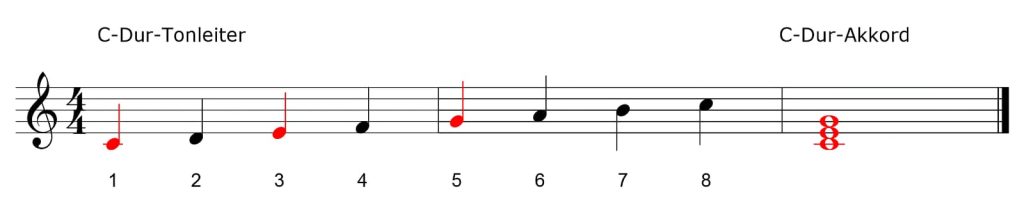
The first method is to use scales since a chord is usually made up of the first, third, and fifth notes of its corresponding scale. For example, in the case of the C major chord, you would use the first, third, and fifth notes of the C major scale.

The notes 1, 3 and 5 of a scale make a chord. That is why it is named after the root note of the scale.

However, this method requires knowledge of the scale, which can be a challenge for beginners.

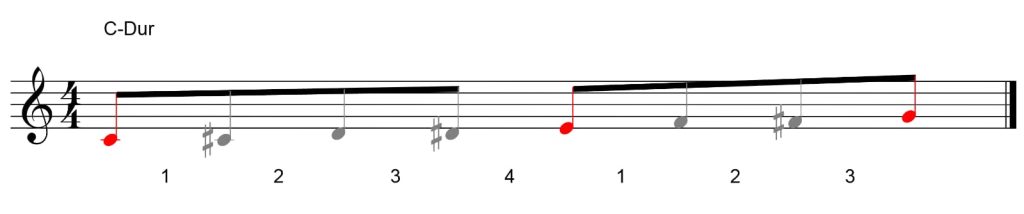
The second option is much simpler, as it involves counting the semitone intervals between the first and second notes, as well as the second and third notes of the chord. With the piano keys laid out in front of you, this method is particularly easy to learn.

Learning to play piano chords made easy: It's quite simple to understand once you become aware of the distances between chord tones.

What Are the Different Chord Types?

There are four main chord types: Major, Minor, Augmented, and Diminished. They differ in the specific intervals between the three notes of the chord.

The notes of the four chord types are spaced differently.

For a major chord, you move up four semitones from the root note, then three. For a minor chord, it’s the opposite: you move up three semitones, then four. An augmented chord consists of two intervals of four semitones, while a diminished chord is made up of two intervals of three semitones. As you can see, learning to play piano chords doesn’t have to be complicated. Here’s a summary of the chord types and the semitone intervals they consist of:

Major: 4 – 3

Minor: 3 – 4

Augmented: 4 – 4

Diminished: 3 – 3

Forming a Piano Chord

Using the method explained earlier, forming any piano chord becomes straightforward. Let’s take the E major chord as an example:

  • Start by playing the root note of the chord, E, with your right hand.
  • With your left hand, count up four semitones from the root. Remember, you are not counting the root note itself – just the steps it takes to get from one note to the next in the chord.
  • This brings us to the note G-sharp, which you will also play with your right hand.
  • Next, count up three semitones from G-sharp, and you’ll land on B.
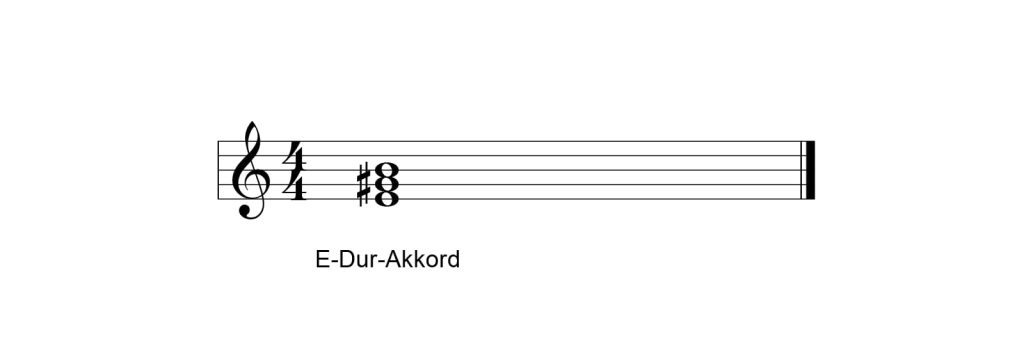
  • The E major chord, therefore, consists of the notes E, G-sharp, and B, and looks like this in musical notation.
The E major chord consists of the notes E, G sharp and B.

How to Determine a Chord on the Piano

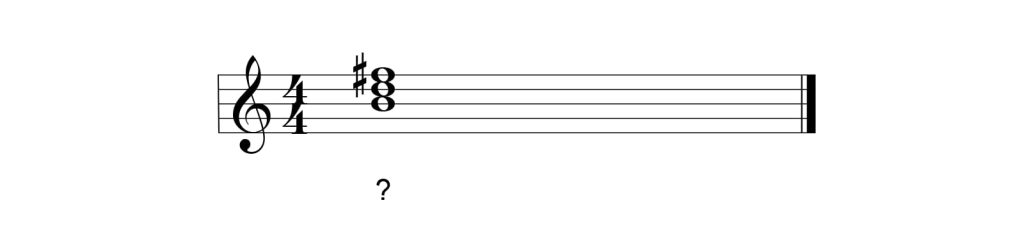
To identify an existing chord, we reverse the process. First, read the notes of the chord from a piece of music and play them with your right hand on the piano. For example, let’s say we come across this chord in the sheet music:

What is the name of this chord? Rely on the spacing of the notes in semitones to determine it as well.

Once the notes are played on the piano, use your left hand to count the semitones between the root note and the second note. Then do the same from the second to the third note. In this case, the first interval consists of three semitones, and the second of four, indicating a minor chord.

To fully identify the chord, we also need the name of its root note. In our example, the root note is B, so the full name of the chord is B minor.

Practice Playing Piano Chords

Form and identify as many chords as possible. Always rely on counting the intervals rather than guessing, as this will help you master chord formation more accurately. With consistent practice, you’ll soon be able to form, recognize, and play any piano chord with ease. Keep at it, it’s worth the effort!

It’s important to mix theory with practice – especially as a beginner. After all, learning chords should always include playing them on the piano! After you form a chord, play it several times and focus on achieving a smooth, even harmony. Remember, it’s more important to maintain a balanced sound than to play each note exactly the same way. Rigidly uniform playing can feel awkward and sound as mechanical as a virtual piano.

How to Read and Play Piano Chords – Part 2

Now that you’ve learned about triads, you may be curious about how these chords fit into a piece of music. Perhaps you’ve encountered terms like “tonic” or “cadence” and are wondering how they relate to what you’ve just learned. However, let’s take it step by step. In the next part of this workshop series, we will explore concepts such as root position and inversions of piano chords to prepare you for more complex topics.

*Affiliate link. These “advertising links” help us finance our website. If you buy a product through such a link, we receive a small commission – at no extra cost for you. The PIANOO.de team says thank you for your support!

ADVERTISEMENT

Related Articles

26.10.2026 · Buy Gifts for Musicians: Is a Piano the Only Option?

It doesn't have to be a grand piano—there are plenty of small and inexpensive gifts for musicians to choose from.

20.09.2025 · Buy Yamaha CLP-800 Series – Reviewing Clavinova Digital Pianos

In fall 2024, Yamaha announced the new CLP-800 series. The key refinements concern the sound generation and playback systems.

01.09.2025 · Buy Buyer’s Guide: A Portable Piano Under $2,000

With a scaled-down cabinet and speaker system, a portable piano under $2,000 offers a great keyboard and sound engine.

20.02.2025 · Buy Studiologic SL-mk2 Series – USB MIDI Controllers

The Italian manufacturer has introduced the new models of the Studiologic SL-mk2 series with new features and improved details.

20.02.2025 · Buy Speakers and Piano Sound: How Good Can Digital Pianos Really Sound?

Speakers and piano sound — does your digital piano sound better when you're using headphones? Find out why here.

13.02.2025 · Buy Kawai CN Series: CN-201 & CN-301

With their high-quality playability, the digital pianos in the Kawai CN series inspire both demanding beginners and advanced players.

09.02.2025 · Buy Product Review: Yamaha TransAcoustic Piano - Hybrid Piano

Piano or digital piano? The Yamaha TransAcoustic piano offers the best of both worlds. The perfect blend of acoustic and digital piano.

08.02.2025 · Buy Almost as Good as the Real Thing: Playing a Hybrid Digital Piano

Acoustic soundboard, grand piano action, and wooden keys: A hybrid digital piano combines maximum playing comfort with high-quality sound.

07.02.2025 · Buy Play Piano with Headphones: Hybrid Piano!

Play the piano with headphones - a hybrid piano combines an acoustic piano with a mute function and an electronic sound generation.

15.01.2025 · Buy Best Headphones for Digital Piano: Sound That Inspires

Buying high-quality headphones for digital piano: Why invest in good digital piano headphones and how much do they cost?

13.01.2025 · Buy Kawai ES Series: ES-920, ES520, ES-120, ES-60 – Portable Pianos

The Kawai ES Series is popular with beginners and advanced players alike: High-quality features at prices ranging from $400 to $1,200.

22.12.2024 · Buy Wireless MIDI: Play Piano or Keyboard Without Cables

Wireless MIDI systems are useful when the instruments themselves are not Bluetooth-compatible. But what makes a good Wireless MIDI adapter?