Jamie Saft

Jamie Saft (Photo: Peter Gannushkin)
(Photo: Peter Gannushkin)
ADVERTISEMENT

On the audacity and truth of improvisation—calling Jamie Saft a jazz pianist is certainly accurate, but it describes only one facet of his work. He studied at the New England Conservatory of Music, has written film scores, and has released many albums on which he serves as producer, musician, and bandleader all at once.

ADVERTISEMENT
ADVERTISEMENT

And he sets a breathtaking pace with his work. Shortly after our conversation about the album Hidden Colors, which he recorded with Dave Liebman, Bradley Christopher Jones, and Hamid Drake, he already released his next work.

Jamie Saft, Producer

“Yes, that’s actually my favorite thing to do,” says Jamie. “Making records, working in the studio, recording, producing. I’m really happy to be able to work in my own studio, which is also my home. Most of my albums come out of this studio. It’s a huge advantage because I can invite everyone over and we can compose, jam, and record right away—all in one place.”

How do your albums and projects come about?

Jamie: It varies a lot. Often, I imagine a lineup of specific musicians that I’d love to hear play together. I try to get them all together in the studio for a session, but then it really depends on how I perceive the music in that moment. I approach recordings equally as a producer and as a composer. I always follow my vision of how I’d like to hear this group of musicians play and try to capture that on record.

Sometimes, entire takes emerge from spontaneous improvisations that we record right away. But there are also situations where I’ve composed something beforehand. Regardless of whether it’s improvisation or composition, 99% of the tracks on the albums are first takes.

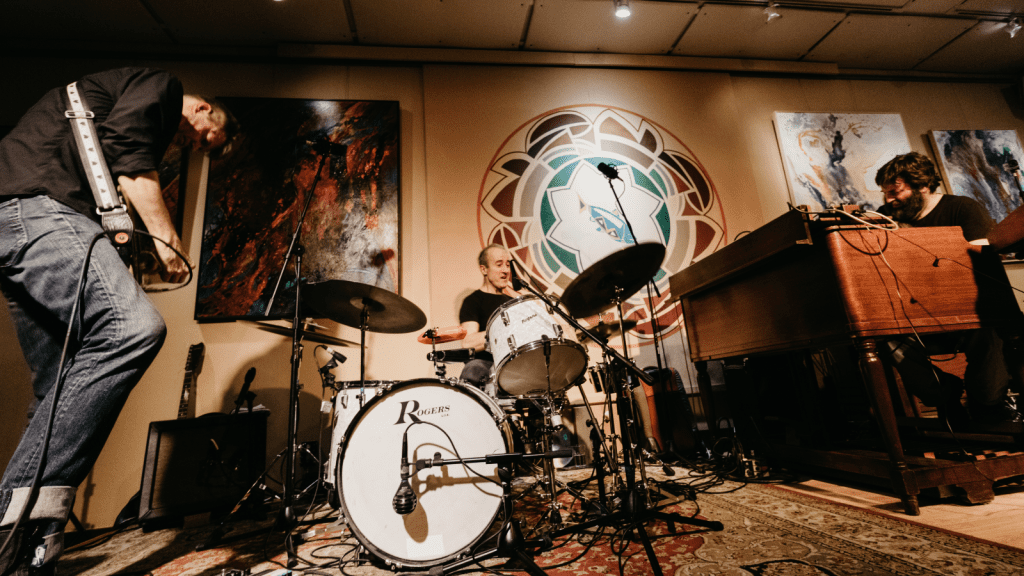
Jamie Saft – Live Session with the "Previte, Saft, Cline" Band
Capturing the performance and transforming it into an immersive listening experience: Many of the tracks on Jamie Saft's albums are the result of live improvisations.

Jamie Saft, Improviser

This “first-take” approach is probably why the pieces sound so fresh and lively. There’s always a certain tension between the musicians that captures the listener’s attention. “You can feel the musicians communicating with each other at every moment,” Jamie continues. “That’s also what makes it special when you work with really good musicians. And I’m glad that I have access to such a wide range of talented people here. Especially when it comes to improvising, you don’t have to explain anything to them.”

This interplay is probably the miracle or the mystery of music.

Jamie: It’s one of the many miracles of music. But yes, I think that first impression you get during a session is very important. Especially when you’re playing something together for the first time, there’s something very special about that freshness that nothing else can replace.

On that note, we have to mention the 1970s Krautrock band Can, who pursued a very similar concept. They called it “instant composing.”

Jamie: Yes, a great band. With every recording, session, or even live show, we, too, strive to ensure that everything we play ultimately meets the standard of a good album. Depending on the situation, we use different strategies, but I always try to keep the big picture in mind without getting too bogged down in the details. We establish a certain musical architecture, and for everything else, we rely entirely on our ensemble playing.

…we trust our ensemble playing and follow the path the music shows us.
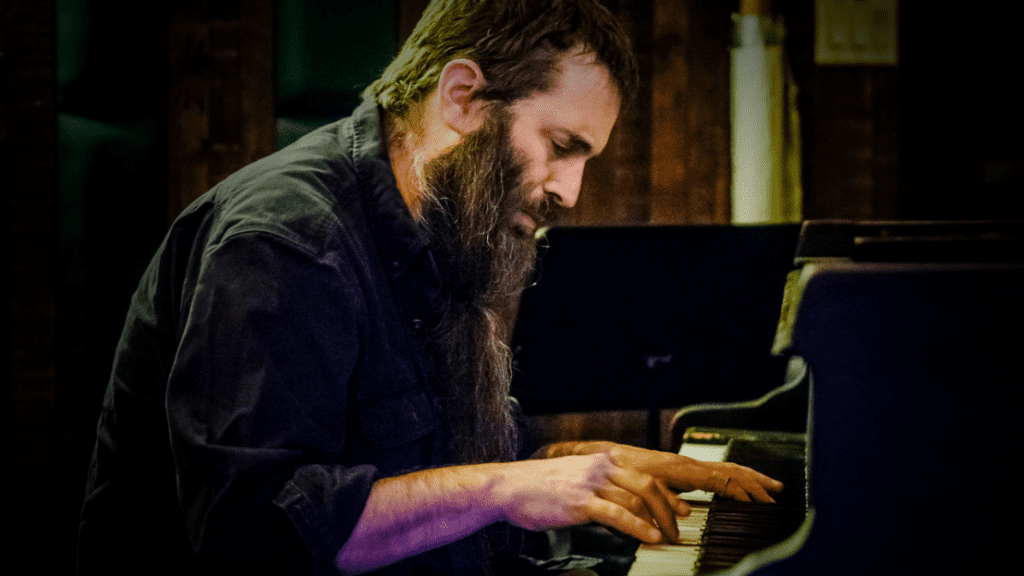
Jamie Saft Solo Piano (Photo: Peter Gannushkin)
Jamie Saft – Solo Piano (Photo: Peter Gannushkin)

Jamie Saft, Bandleader

When you’re improvising, are there ever moments when you think: Just don’t mess this up, don’t overdo it, don’t lose the flow…

Jamie: Of course I’ve had moments like that, but I’ve found a way to deal with them. Thoughts like that take you out of the flow. You can avoid that by not constantly judging and evaluating. But as I said before, we trust our ensemble playing and follow the path the music shows us.

The term “bandleader” takes on an interesting twist in this context…

Jamie: The term is pretty well-defined, but as a leader or producer, you don’t necessarily have to dictate things, but do need to be able to set a direction. There’s this crucial moment when you simply have to let go of a preconceived idea like, “This is how it should be!” Instead, you want to be right in the thick of what’s happening. And you make the most of whatever you’re doing in the moment.

… and that goes for every single person in the band.

Jamie: When you’re playing at a high level with experienced improvisers, everyone intuitively knows how to give each other space and support one another. I consider myself truly lucky to have been able to play improvised music with some of my greatest heroes for decades now. Joe Morris, Roswell Rudd, Charles Downs, Dave Liebman—all people who’ve had extensive experience with improvised music in a wide variety of contexts. They know exactly how to play each piece. I’ve learned a great deal from them.

Learning From the Heroes

Jamie: Ultimately, the collective improvisational experience defines the music. It’s like a conversation, a constantly evolving dialogue. And the greatest musicians and improvisers are constantly refining what they do. But what’s crucial is that they really listen, and they’re always learning.

The conversation between the musicians never fails to thrill me at good live concerts.

Jamie: What the audience hears and perceives at a concert is, above all, the interaction on stage. Listening to a CD or vinyl at home is a completely different experience than experiencing the moment when people are playing right in front of you on stage.

The magic of the moment. As an audience member, you’re somehow part of the action, so even a recording or a video can’t convey the same thing. But how do you record an album of improvised music?

Jamie: That’s the big challenge! It’s a question of how you record it. Do you simply record the performance and leave it as raw as possible? Or do you shape the form of the improvisation to match how you want to present it to the audience through the recorded medium?

To figure that out, I started setting up my own studio early on. Albums like Jimi Hendrix’s Electric Lady Land or Miles Davis’s Bitches Brew have always served as a kind of benchmark for me. To me, these albums represent well-recorded performances by special groups of musicians. Even today, these albums sound as vibrant and important as they did 50 years ago.

When I listen to records like these, I lose myself in the sonic universe of these recordings. And regardless of whether I can achieve it or not—that’s exactly what I strive for with my own records. I want to give my listeners this immersive listening experience. Ideally, I want to transport them from the noise and stress of everyday life into a new environment. Music is transformative and transcends all languages and borders. As musicians, we must be mindful of our responsibility to use this power of music for the good in people. I approach every recording and every concert with this mindset.

The Healing Power of Music

In the liner notes for Hidden Corners, I read a statement about the healing power of music. In fact, when I listen to the album, I feel that the tracks have a meditative quality to them.

Jamie: I think every style of music can induce an immersive or meditative state, whether you’re attending an opera, a reggae concert, or a black metal show. You can find the transformative power of music everywhere. I want a concert to have something sublime about it. I want to feel better afterward than I did before.

That’s exactly how I felt with the very first track on Hidden CornersPositive Way instantly transported me to a beautiful place. It takes you there right away.

Jamie: That’s wonderful. Because I felt exactly the same way when I was playing it. Whenever I play, I want to take my listeners to a beautiful place. And—it might sound selfish—I want to get there myself.

Monk's Mood radically changed my musical direction back then.

On Positive Way, a playful element of yours really comes through, which I really like. It has that calm, harmonic quality of Bill Evans, as well as a repetitive quality that, thanks to constant small variations, never repeats exactly yet never pulls you out of the flow of the music. Rhythmically, it’s always a bit “odd,” which reminds me a little of Thelonious Monk, though you couldn’t say you play “like” Monk or Evans.

Jamie: Oh, that’s a huge compliment, because both of those pianists are my great role models. I’d even say that Thelonious Monk is the reason I play jazz. When I came to New York in the ’70s, I listened to the music of that era: Bob Dylan, Bob Marley, Joni Mitchell, AC/DC, Peter Tosh, Stevie Wonder, and so on—until a classmate handed me a Monk record. Monk’s Mood radically changed my musical direction back then.

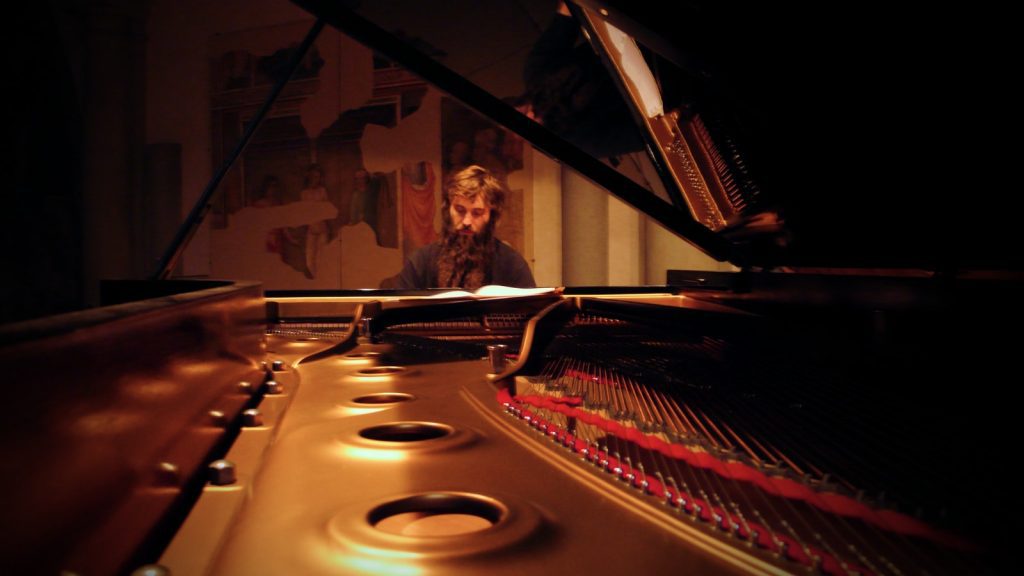
Jamie Saft on the Grand Piano (Photo: VinCin)

How to Get a Great Sound on the Piano

Jamie: Thelonious Monk and Bill Evans are my absolute piano heroes in jazz, but there are others as well. As a child, I took classical piano lessons from a true virtuoso: Burton Hatheway. He studied at the Manhattan School of Music and has a fantastic understanding of how to teach tone production on the piano, with all its physical and mechanical aspects. From him, I learned early on how to produce a good tone through my playing technique.

Do you mean how to transfer the force from your fingers to the keys, hammers, strings…?

Jamie: Exactly. When you play the piano, you can’t get around the laws of physics. And if you want to learn how to play the piano properly, you have to learn how to let gravity do the work for you. When you listen to pianists who can produce a magnificent tone on a grand piano, you’ll always find elements of this pianistic technique.

Vladimir Horowitz is the prime example of mastering the physics of piano sound with seemingly no effort. He could play the most virtuosic piano music without much physical exertion. Horowitz wasn’t a tall, strong man, yet even at the age of 70, he was still able to play Rachmaninoff at a concert level.

I clearly remember two pictures of Horowitz hanging above my piano teacher’s piano. One showed his hands on the keyboard. The other showed him eating. And from the way Horowitz balanced the fork between his fingers, you could see how he used gravity in much the same way as when playing the piano.

In other words: I was very lucky to learn piano technique at an early age. Years later, when I began exploring jazz heroes like Monk, Evans, Miles Davis, John Coltrane, and Alice Coltrane, I realized just how much that benefited me. I had no technical difficulties playing, so I could focus entirely on the music and improvisation.

… and the tone—in the sense of: sound!

Jamie: Yes, absolutely. When you’re improvising, nothing is dictated to you. That’s why it’s so incredibly important to produce a good sound and shape the right tone with the appropriate color and intensity. By that, I mean the whole context of everything you play, how you move from one note to the next. All great players have a distinctive tone that sets them apart. Just think of Jimi Hendrix and his guitar sound, but also Bill Evans—and, of course, Monk.

Monk's technique is directly connected to his harmonic and rhythmic universe.

When it comes to tone, opinions are divided on Monk.

Jamie: I know there are always people who simply question Monk’s playing technique. But I see it quite differently, because he found the perfect tone for his music. In my opinion, it’s one of the greatest piano sounds in the world. Monk’s technique is directly connected to his harmonic and rhythmic universe. It all goes together.

It’s always a bit difficult to consistently transfer these tonal possibilities of the acoustic piano to a digital instrument. In terms of tone production, when you play a sampled piano, you’re playing a sound that someone else has already created or shaped.

Jamie: To me, the acoustic piano sound or the acoustic piano itself is something of a technical marvel. You can draw such an immense range of tonal nuances from a piano and shape the attack of the note through touch alone. That’s what I find so fantastic about the instrument.

You were just talking about the physics of playing the piano. Isn’t it a common misconception among many aspiring pianists to equate sound volume with the force of the keystroke? In German, this misconception probably stems from the word Angschlagsstärke, which literally means “keystroke strength.” In English, the term “velocity” is used for this, meaning the speed of the keystroke.

Jamie: You can’t outsmart physics. There’s a relationship between force, mass, and acceleration. On the piano, you accelerate the mass of the keys and hammers to a certain speed. So it’s a question of how fast, not how hard, you press the key. If you want to move that mass with force, you’ll feel a counteracting force. This technical understanding is, I’d say, the foundation for achieving a big sound when playing the piano.

We’ve talked a lot about the piano, but you also play electronic instruments, such as organs and synthesizers. On the album You Don’t Know The Life, you can’t even hear a piano at all.

Jamie: I’d say it’s 90 percent Hammond organ, plus a few other instruments. There’s this White Hall organ, a transistor combo organ, and one track features the Baldwin Electric Harpsichord. You can hear it right on the album’s first track—it’s based on Bill Evans’s piece Re: Person I Knew.

The Baldwin Electric Harpsichord is a very rare vintage keyboard. It has that wiry ’60s sound that I think people recognize from film scores of that era.

Jamie: The Beatles played the electric harpsichord, as did Call Cobbs during his time with Albert Ayler. The sound has always fascinated me. It’s similar to the Hohner Clavinet, but also totally different. And somehow it was the perfect fit for the Bill Evans piece. But as I said, on most tracks I play the Hammond.

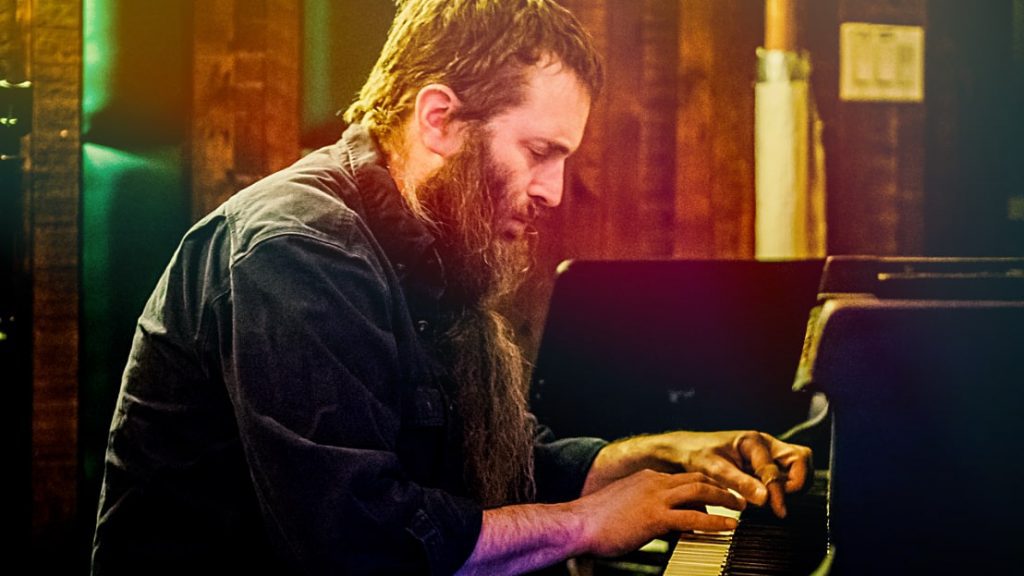
What could be better than making music together with your heroes?

Some of the tracks have the typical sound of a ’60s jazz organ trio, but then there’s the track The Break of The Flat Land, where you break away from the cliché of the Hammond sound and use the instrument in a fantastically atmospheric and downright soundscape-like way.

Jamie: I’m incredibly happy that you brought up this track. It’s very important to me because it’s the only track on this album that emerged from a collective improvisation between Steve Swallow, Bobby Previte, and me. And I’m glad you feel the magic of this recording as well. I really have to say this: With this album, as with many others, it makes me happy that I was able to create it with such great musicians. Steve Swallow, Bobby Previte, and Dave Liebman—they’re all exceptionally talented jazz musicians and improvisers who have been honing their craft for decades. They’re my jazz heroes. And what could be better than making music together with your heroes?

Studio Session: Jamie Saft (Piano), Steve Swallow (Bass Guitar), and Bobby Previte (Drums)

You are currently viewing a placeholder content from YouTube. To access the actual content, click the button below. Please note that doing so will share data with third-party providers.

More Information
ADVERTISEMENT

Related Articles

20.09.2025 · Buy Yamaha CLP-800 Series – Reviewing Clavinova Digital Pianos

In fall 2024, Yamaha announced the new CLP-800 series. The key refinements concern the sound generation and playback systems.

01.09.2025 · Buy Buyer’s Guide: A Portable Piano Under $2,000

With a scaled-down cabinet and speaker system, a portable piano under $2,000 offers a great keyboard and sound engine.

20.02.2025 · Buy Studiologic SL-mk2 Series – USB MIDI Controllers

The Italian manufacturer has introduced the new models of the Studiologic SL-mk2 series with new features and improved details.

20.02.2025 · Buy Speakers and Piano Sound: How Good Can Digital Pianos Really Sound?

Speakers and piano sound — does your digital piano sound better when you're using headphones? Find out why here.

13.02.2025 · Buy Kawai CN Series: CN-201 & CN-301

With their high-quality playability, the digital pianos in the Kawai CN series inspire both demanding beginners and advanced players.

09.02.2025 · Buy Product Review: Yamaha TransAcoustic Piano - Hybrid Piano

Piano or digital piano? The Yamaha TransAcoustic piano offers the best of both worlds. The perfect blend of acoustic and digital piano.

08.02.2025 · Buy Almost as Good as the Real Thing: Playing a Hybrid Digital Piano

Acoustic soundboard, grand piano action, and wooden keys: A hybrid digital piano combines maximum playing comfort with high-quality sound.

07.02.2025 · Buy Play Piano with Headphones: Hybrid Piano!

Play the piano with headphones - a hybrid piano combines an acoustic piano with a mute function and an electronic sound generation.

15.01.2025 · Buy Best Headphones for Digital Piano: Sound That Inspires

Buying high-quality headphones for digital piano: Why invest in good digital piano headphones and how much do they cost?

13.01.2025 · Buy Kawai ES Series: ES-920, ES520, ES-120, ES-60 – Portable Pianos

The Kawai ES Series is popular with beginners and advanced players alike: High-quality features at prices ranging from $400 to $1,200.

22.12.2024 · Buy Wireless MIDI: Play Piano or Keyboard Without Cables

Wireless MIDI systems are useful when the instruments themselves are not Bluetooth-compatible. But what makes a good Wireless MIDI adapter?

20.12.2024 · Buy Studiologic SL Series: SL73/88 Studio, SL88 Grand, SL|Mixface

The Studiologic SL series offers USB MIDI controllers with high-qualtiy hammer action keyboards for MIDI studio and live use.